
Get complete NCERT Solutions for Class 12 Chemistry Chapter 9 Amines with step-by-step answers, chemical reactions, conversions and explanations for board exams, JEE and NEET.
NCERT Solutions Class 12 Chemistry Chapter 9 Amines | Complete Solutions
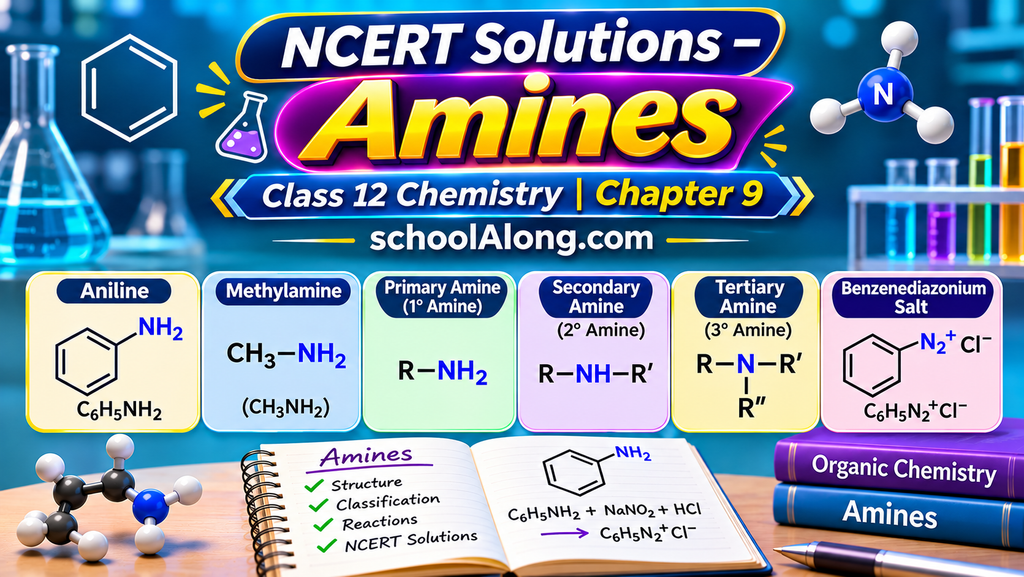
Amines is an important chapter in Class 12 Organic Chemistry. It covers the classification, nomenclature, preparation and reactions of amines, along with the preparation and chemical reactions of diazonium salts.
These NCERT Solutions for Class 12 Chemistry Chapter 9 – Amines provide step-by-step answers to textbook exercises, chemical equations, organic conversions and explanations to help students understand the concepts and prepare for board examinations, JEE and NEET.
📚 Chapter Contents
- Amines: Structure, Classification and Nomenclature
- Preparation and Properties of Amines
- Basic Strength of Amines
- Chemical Reactions of Amines
- Diazonium Salts and Their Reactions
- NCERT Exercise Solutions (9.1–9.14)
🧪 NCERT Exercise Solutions – Amines
9.1 Write IUPAC names of the following compounds and classify them into primary, secondary and tertiary amines.
(i) (CH₃)₂CHNH₂
IUPAC name: Propan-2-amine
Class: Primary amine
(ii) CH₃(CH₂)₂NH₂
IUPAC name: Propan-1-amine
Class: Primary amine
(iii) CH₃NHCH(CH₃)₂
IUPAC name: N-Methylpropan-2-amine
Class: Secondary amine
(iv) (CH₃)₃CNH₂
IUPAC name: 2-Methylpropan-2-amine
Class: Primary amine
(v) C₆H₅NHCH₃
IUPAC name: N-Methylbenzenamine (N-methylaniline)
Class: Secondary amine
(vi) (CH₃CH₂)₂NCH₃
IUPAC name: N-Ethyl-N-methylethanamine
Class: Tertiary amine
(vii) m-BrC₆H₄NH₂
IUPAC name: 3-Bromobenzenamine (3-bromoaniline)
Class: Primary amine
9.2 Give one chemical test to distinguish between the following pairs of compounds.
(i) Methylamine and dimethylamine
Carbylamine test
Heat the compounds with chloroform (CHCl₃) and alcoholic KOH.
- Methylamine (primary amine) gives foul-smelling methyl isocyanide.
- Dimethylamine (secondary amine) does not give this reaction.
CH₃NH₂ + CHCl₃ + 3KOH → CH₃NC + 3KCl + 3H₂O
(ii) Secondary and tertiary amines
Hinsberg test
Treat the compounds with benzenesulphonyl chloride (C₆H₅SO₂Cl) in aqueous alkali.
- Secondary amines form sulphonamides that are insoluble in alkali.
- Tertiary amines do not react with Hinsberg’s reagent under these conditions but dissolve in dilute acid by forming ammonium salts.
(iii) Ethylamine and aniline
Add bromine water.
- Aniline gives a white precipitate of 2,4,6-tribromoaniline.
- Ethylamine does not give this characteristic white precipitate.
C₆H₅NH₂ + 3Br₂ → 2,4,6-Tribromoaniline + 6HBr
(iv) Aniline and benzylamine
Treat the compounds with NaNO₂ and HCl at 273–278 K.
- Aniline forms a stable benzenediazonium chloride solution.
- Benzylamine, a primary aliphatic amine, forms an unstable diazonium intermediate that decomposes with the evolution of nitrogen gas.
(v) Aniline and N-methylaniline
Use the carbylamine test.
- Aniline gives foul-smelling phenyl isocyanide.
- N-Methylaniline does not give the carbylamine reaction because it is a secondary amine.
9.3 Account for the following.
(i) pKb of aniline is more than that of methylamine.
Aniline is a weaker base than methylamine.
In aniline, the lone pair of electrons on nitrogen is delocalised into the benzene ring through resonance. Therefore, it is less available for accepting a proton.
In methylamine, the methyl group shows a +I effect and increases electron density on nitrogen.
Hence, methylamine is a stronger base and has a lower pKb value than aniline.
(ii) Ethylamine is soluble in water whereas aniline is not.
Ethylamine forms hydrogen bonds with water and has a relatively small hydrophobic alkyl group.
Aniline contains a large hydrophobic benzene ring, which reduces its solubility in water.
Therefore, ethylamine is much more soluble in water than aniline.
(iii) Methylamine in water reacts with ferric chloride to precipitate hydrated ferric oxide.
Methylamine is basic in nature. It reacts with water to produce hydroxide ions.
CH₃NH₂ + H₂O ⇌ CH₃NH₃⁺ + OH⁻
The hydroxide ions react with ferric ions to form a reddish-brown precipitate of hydrated ferric oxide.
Fe³⁺ + 3OH⁻ → Fe(OH)₃↓
(iv) Although amino group is ortho- and para-directing, aniline on nitration gives a substantial amount of meta derivative.
During nitration, the strongly acidic medium protonates aniline to form the anilinium ion (C₆H₅NH₃⁺).
The anilinium group is deactivating and meta-directing. Therefore, meta-nitroaniline is also formed along with ortho- and para-products.
(v) Aniline does not undergo Friedel-Crafts reaction.
The amino group of aniline reacts with the Lewis acid catalyst AlCl₃ to form a salt or complex.
This reduces the availability of the nitrogen lone pair and makes the aromatic ring strongly deactivated under the reaction conditions.
Therefore, aniline does not undergo the usual Friedel-Crafts alkylation or acylation.
(vi) Diazonium salts of aromatic amines are more stable than those of aliphatic amines.
Arenediazonium ions are stabilised by resonance involving the aromatic ring.
Alkyldiazonium ions do not receive this resonance stabilisation and readily decompose with the release of nitrogen gas.
Therefore, aromatic diazonium salts are more stable at low temperatures.
(vii) Gabriel phthalimide synthesis is preferred for synthesising primary amines.
Gabriel phthalimide synthesis produces primary amines without forming a mixture of primary, secondary and tertiary amines.
It is therefore a useful method for preparing pure primary aliphatic amines.
It cannot be used to prepare aromatic primary amines.
9.4 Arrange the following.
(i) In decreasing order of pKb values:
C₂H₅NH₂, C₆H₅NHCH₃, (C₂H₅)₂NH and C₆H₅NH₂
Answer:
C₆H₅NH₂ > C₆H₅NHCH₃ > C₂H₅NH₂ > (C₂H₅)₂NH
Higher pKb means weaker basic strength.
(ii) In increasing order of basic strength:
C₆H₅NH₂, C₆H₅N(CH₃)₂, (C₂H₅)₂NH and CH₃NH₂
Answer:
C₆H₅NH₂ < C₆H₅N(CH₃)₂ < CH₃NH₂ < (C₂H₅)₂NH
(iii) In increasing order of basic strength:
(a) Aniline, p-nitroaniline and p-toluidine
p-Nitroaniline < Aniline < p-Toluidine
The –NO₂ group decreases basic strength through its electron-withdrawing effect, whereas –CH₃ increases it through its electron-releasing effect.
(b) C₆H₅NH₂, C₆H₅NHCH₃, C₆H₅CH₂NH₂
C₆H₅NH₂ < C₆H₅NHCH₃ < C₆H₅CH₂NH₂
In benzylamine, the nitrogen lone pair is not directly conjugated with the benzene ring.
(iv) In decreasing order of basic strength in gas phase:
C₂H₅NH₂, (C₂H₅)₂NH, (C₂H₅)₃N and NH₃
Answer:
(C₂H₅)₃N > (C₂H₅)₂NH > C₂H₅NH₂ > NH₃
In the gas phase, the +I effect of additional alkyl groups increases electron density on nitrogen.
(v) In increasing order of boiling point:
C₂H₅OH, (CH₃)₂NH, C₂H₅NH₂
Answer:
(CH₃)₂NH < C₂H₅NH₂ < C₂H₅OH
Alcohols form stronger intermolecular hydrogen bonds than comparable amines. Primary amines form stronger intermolecular hydrogen bonding than secondary amines of comparable molar mass.
(vi) In increasing order of solubility in water:
C₆H₅NH₂, (C₂H₅)₂NH, C₂H₅NH₂
Answer:
C₆H₅NH₂ < (C₂H₅)₂NH < C₂H₅NH₂
The large hydrophobic benzene ring decreases the water solubility of aniline.
9.5 How will you convert the following?
(i) Ethanoic acid into methanamine
Ethanoic acid is first converted into ethanamide, which undergoes Hofmann bromamide degradation.
CH₃COOH → CH₃CONH₂ → CH₃NH₂
Reactions:
CH₃COOH + NH₃ → CH₃COONH₄
CH₃COONH₄ —Δ→ CH₃CONH₂ + H₂O
CH₃CONH₂ + Br₂ + 4NaOH → CH₃NH₂ + 2NaBr + Na₂CO₃ + 2H₂O
(ii) Hexanenitrile into 1-aminopentane
First hydrolyse hexanenitrile to hexanoic acid, convert it into hexanamide and then perform Hofmann bromamide degradation.
CH₃(CH₂)₄CN → CH₃(CH₂)₄COOH → CH₃(CH₂)₄CONH₂ → CH₃(CH₂)₃CH₂NH₂
The final product is pentan-1-amine (1-aminopentane).
(iii) Methanol to ethanoic acid
Convert methanol into a methyl halide, then into a nitrile, followed by hydrolysis.
CH₃OH → CH₃Br → CH₃CN → CH₃COOH
Reagents: HBr; alcoholic KCN; acidic hydrolysis.
(iv) Ethanamine into methanamine
Ethanamine is converted into ethanol using nitrous acid. Oxidation gives ethanoic acid, which is converted into ethanamide and then methanamine.
C₂H₅NH₂ → C₂H₅OH → CH₃COOH → CH₃CONH₂ → CH₃NH₂
(v) Ethanoic acid into propanoic acid
Reduce ethanoic acid to ethanol, convert it into bromoethane, and increase the carbon chain using KCN.
CH₃COOH → C₂H₅OH → C₂H₅Br → C₂H₅CN → C₂H₅COOH
(vi) Methanamine into ethanamine
Convert methanamine into methanol using nitrous acid. Then prepare methyl bromide, followed by nitrile formation and reduction.
CH₃NH₂ → CH₃OH → CH₃Br → CH₃CN → C₂H₅NH₂
(vii) Nitromethane into dimethylamine
Reduce nitromethane to methylamine and then perform alkylation with a methyl halide.
CH₃NO₂ → CH₃NH₂ → (CH₃)₂NH
Reagents: Sn/HCl or H₂/Ni for reduction; controlled methylation using CH₃I.
(viii) Propanoic acid into ethanoic acid
Convert propanoic acid into propanamide, then perform Hofmann degradation to obtain ethanamine. Treat ethanamine with nitrous acid to obtain ethanol and oxidise it to ethanoic acid.
CH₃CH₂COOH → CH₃CH₂CONH₂ → CH₃CH₂NH₂ → CH₃CH₂OH → CH₃COOH
9.6 Describe a method for the identification of primary, secondary and tertiary amines. Also write chemical equations.
Hinsberg test is used to distinguish primary, secondary and tertiary amines.
The reagent is benzenesulphonyl chloride (C₆H₅SO₂Cl).
Primary amine (1°)
It reacts with Hinsberg’s reagent to form N-alkylbenzenesulphonamide.
The product contains an acidic N–H hydrogen and dissolves in alkali by forming a salt.
RNH₂ + C₆H₅SO₂Cl → C₆H₅SO₂NHR + HCl
Secondary amine (2°)
It forms N,N-dialkylbenzenesulphonamide, which has no N–H hydrogen and is insoluble in alkali.
R₂NH + C₆H₅SO₂Cl → C₆H₅SO₂NR₂ + HCl
Tertiary amine (3°)
It does not react with Hinsberg’s reagent. However, it dissolves in dilute acid by forming an ammonium salt.
R₃N + HCl → R₃NH⁺Cl⁻
Conclusion: The difference in reaction and solubility helps identify the three classes of amines.
9.7 Write short notes on the following.
(i) Carbylamine Reaction
Primary aliphatic and aromatic amines react with chloroform and alcoholic KOH on heating to produce foul-smelling isocyanides.
RNH₂ + CHCl₃ + 3KOH → RNC + 3KCl + 3H₂O
Only primary amines give this reaction. It is used as a test for primary amines.
(ii) Diazotisation
The conversion of a primary aromatic amine into a diazonium salt using nitrous acid at 273–278 K is called diazotisation.
C₆H₅NH₂ + NaNO₂ + 2HCl → C₆H₅N₂⁺Cl⁻ + NaCl + 2H₂O
The reaction is carried out at 273–278 K because the diazonium salt is stable only at low temperature.
(iii) Hofmann’s Bromamide Reaction
An amide reacts with bromine and aqueous or ethanolic NaOH to produce a primary amine containing one carbon atom less than the original amide.
RCONH₂ + Br₂ + 4NaOH → RNH₂ + 2NaBr + Na₂CO₃ + 2H₂O
(iv) Coupling Reaction
Arenediazonium salts react with phenols or aromatic amines to form azo compounds containing the –N=N– group.
Example:
Benzenediazonium chloride + Phenol → p-Hydroxyazobenzene
These products are often coloured and are used as azo dyes.
(v) Ammonolysis
Alkyl halides react with alcoholic ammonia to produce amines. This process is called ammonolysis.
RX + NH₃ → RNH₂ + HX
The primary amine formed can further react with alkyl halides to produce secondary and tertiary amines and finally quaternary ammonium salts.
(vi) Acetylation
Primary and secondary amines react with acid anhydrides or acid chlorides to form amides.
Example:
C₆H₅NH₂ + (CH₃CO)₂O → C₆H₅NHCOCH₃ + CH₃COOH
Aniline forms acetanilide.
Acetylation is also used to protect the amino group during electrophilic substitution reactions.
(vii) Gabriel Phthalimide Synthesis
Phthalimide is treated with ethanolic KOH to form potassium phthalimide. It reacts with an alkyl halide, followed by alkaline hydrolysis, to produce a primary amine.
This method is useful for preparing primary aliphatic amines. It cannot be used to prepare aromatic primary amines because aryl halides do not undergo the required nucleophilic substitution.
9.8 Accomplish the following conversions.
(i) Nitrobenzene to benzoic acid
Nitrobenzene → Aniline → Benzenediazonium chloride → Benzonitrile → Benzoic acid
Reagents:
- Sn/HCl
- NaNO₂/HCl, 273–278 K
- CuCN
- Acidic hydrolysis
(ii) Benzene to m-bromophenol
Benzene → Nitrobenzene → m-Bromonitrobenzene → m-Bromoaniline → m-Bromobenzenediazonium chloride → m-Bromophenol
Reagents:
- Conc. HNO₃/H₂SO₄
- Br₂/Fe
- Sn/HCl
- NaNO₂/HCl, 273–278 K
- Warm water
The –NO₂ group directs bromination to the meta position.
(iii) Benzoic acid to aniline
Benzoic acid → Benzamide → Aniline
Reagents:
- Convert benzoic acid into benzamide using NH₃ followed by heating.
- Br₂/NaOH for Hofmann bromamide degradation.
(iv) Aniline to 2,4,6-tribromofluorobenzene
Aniline → 2,4,6-Tribromoaniline → 2,4,6-Tribromobenzenediazonium salt → 2,4,6-Tribromofluorobenzene
Reagents:
- Br₂(aq)
- NaNO₂/HCl, 273–278 K
- HBF₄, followed by heating
The diazonium group is replaced by fluorine through the Balz–Schiemann reaction.
(v) Benzyl chloride to 2-phenylethanamine
C₆H₅CH₂Cl → C₆H₅CH₂CN → C₆H₅CH₂CH₂NH₂
Reagents:
- Alcoholic KCN
- LiAlH₄, followed by hydrolysis
(vi) Chlorobenzene to p-chloroaniline
Chlorobenzene → p-Nitrochlorobenzene → p-Chloroaniline
Reagents:
- Conc. HNO₃/H₂SO₄
- Sn/HCl or Fe/HCl
The para isomer is separated from the ortho isomer before reduction.
(vii) Aniline to p-bromoaniline
Aniline → Acetanilide → p-Bromoacetanilide → p-Bromoaniline
Reagents:
- Acetic anhydride
- Br₂ in acetic acid
- Hydrolysis
Acetylation protects the amino group and helps obtain the para-substituted product as the major product.
(viii) Benzamide to toluene
Benzamide → Aniline → Benzene → Toluene
Reagents:
- Br₂/NaOH
- NaNO₂/HCl, followed by H₃PO₂ to obtain benzene from the diazonium salt
- CH₃Cl/anhydrous AlCl₃
(ix) Aniline to benzyl alcohol
Aniline → Benzene → Toluene → Benzyl chloride → Benzyl alcohol
Reagents:
- NaNO₂/HCl, 273–278 K, followed by H₃PO₂
- CH₃Cl/anhydrous AlCl₃
- Cl₂ under controlled side-chain chlorination conditions
- Aqueous KOH
9.9 Give the structures of A, B and C in the following reactions.
(i)
CH₃CH₂I —KCN→ A —OH⁻, partial hydrolysis→ B —Br₂/NaOH→ C
- A = CH₃CH₂CN (Propanenitrile)
- B = CH₃CH₂CONH₂ (Propanamide)
- C = CH₃CH₂NH₂ (Ethanamine)
Hofmann degradation removes one carbon atom from the amide.
(ii)
C₆H₅N₂⁺Cl⁻ —CuCN→ A —H₂O/H⁺→ B —NH₃, Δ→ C
- A = C₆H₅CN (Benzonitrile)
- B = C₆H₅COOH (Benzoic acid)
- C = C₆H₅CONH₂ (Benzamide)
(iii)
CH₃CH₂Br —KCN→ A —LiAlH₄→ B —HNO₂, 0°C→ C
- A = CH₃CH₂CN (Propanenitrile)
- B = CH₃CH₂CH₂NH₂ (Propan-1-amine)
- C = CH₃CH₂CH₂OH (Propan-1-ol)
(iv)
C₆H₅NO₂ —Fe/HCl→ A —NaNO₂/HCl, 273 K→ B —H₂O/H⁺, Δ→ C
- A = C₆H₅NH₂ (Aniline)
- B = C₆H₅N₂⁺Cl⁻ (Benzenediazonium chloride)
- C = C₆H₅OH (Phenol)
(v)
CH₃COOH —NH₃, Δ→ A —NaOBr→ B —NaNO₂/HCl→ C
- A = CH₃CONH₂ (Ethanamide)
- B = CH₃NH₂ (Methanamine)
- C = CH₃OH (Methanol)
(vi)
C₆H₅NO₂ —Fe/HCl→ A —HNO₂, 273 K→ B —C₂H₅OH→ C
- A = C₆H₅NH₂ (Aniline)
- B = C₆H₅N₂⁺Cl⁻ (Benzenediazonium chloride)
- C = C₆H₆ (Benzene)
9.10 An aromatic compound A on treatment with aqueous ammonia and heating forms B, which on heating with Br₂ and KOH forms C of molecular formula C₆H₇N. Write structures and IUPAC names.
Aromatic compound A is benzoic acid.
Step 1: Formation of benzamide
C₆H₅COOH + NH₃ → C₆H₅CONH₂ + H₂O
B = Benzamide (Benzenecarboxamide)
Step 2: Hofmann bromamide degradation
C₆H₅CONH₂ + Br₂ + 4KOH → C₆H₅NH₂ + 2KBr + K₂CO₃ + 2H₂O
C = Aniline (Benzenamine)
Answer:
- A = C₆H₅COOH — Benzoic acid
- B = C₆H₅CONH₂ — Benzamide
- C = C₆H₅NH₂ — Aniline
9.11 Complete the following reactions.
(i) C₆H₅NH₂ + CHCl₃ + alc. KOH
C₆H₅NH₂ + CHCl₃ + 3KOH → C₆H₅NC + 3KCl + 3H₂O
Product: Phenyl isocyanide.
(ii) C₆H₅N₂Cl + H₃PO₂ + H₂O
C₆H₅N₂⁺Cl⁻ + H₃PO₂ + H₂O → C₆H₆ + N₂ + H₃PO₃ + HCl
Product: Benzene.
(iii) C₆H₅NH₂ + Conc. H₂SO₄
C₆H₅NH₂ + H₂SO₄ → C₆H₅NH₃⁺HSO₄⁻
On heating at 453–473 K, sulphanilic acid is formed.
Product: p-Aminobenzenesulphonic acid (sulphanilic acid).
(iv) C₆H₅N₂Cl + C₂H₅OH
Benzenediazonium chloride reacts with ethanol to produce benzene.
C₆H₅N₂⁺Cl⁻ + C₂H₅OH → C₆H₆ + N₂ + CH₃CHO + HCl
(v) C₆H₅NH₂ + Br₂(aq)
C₆H₅NH₂ + 3Br₂ → 2,4,6-Tribromoaniline + 6HBr
Product: White precipitate of 2,4,6-tribromoaniline.
(vi) C₆H₅NH₂ + (CH₃CO)₂O
C₆H₅NH₂ + (CH₃CO)₂O → C₆H₅NHCOCH₃ + CH₃COOH
Product: Acetanilide.
(vii) C₆H₅N₂Cl → HBF₄ → NaNO₂/Cu, Δ
First, benzenediazonium chloride reacts with HBF₄ to form benzenediazonium fluoroborate.
C₆H₅N₂⁺Cl⁻ + HBF₄ → C₆H₅N₂⁺BF₄⁻ + HCl
On heating with NaNO₂/Cu, the diazonium group is replaced by –NO₂.
Product: Nitrobenzene (C₆H₅NO₂).
9.12 Why cannot aromatic primary amines be prepared by Gabriel phthalimide synthesis?
Gabriel phthalimide synthesis involves nucleophilic substitution of an alkyl halide by the phthalimide ion.
Aryl halides do not undergo this nucleophilic substitution easily because the carbon–halogen bond in aryl halides has partial double-bond character due to resonance.
Therefore, aromatic primary amines cannot be prepared by Gabriel phthalimide synthesis.
9.13 Write the reactions of (i) aromatic and (ii) aliphatic primary amines with nitrous acid.
(i) Aromatic primary amines
Aromatic primary amines react with nitrous acid at 273–278 K to form stable arenediazonium salts.
C₆H₅NH₂ + NaNO₂ + 2HCl → C₆H₅N₂⁺Cl⁻ + NaCl + 2H₂O
Product: Benzenediazonium chloride.
(ii) Aliphatic primary amines
Aliphatic primary amines react with nitrous acid to form unstable alkyldiazonium salts, which decompose to alcohols with the evolution of nitrogen gas.
RNH₂ + HNO₂ → ROH + N₂↑ + H₂O
Example:
C₂H₅NH₂ + HNO₂ → C₂H₅OH + N₂↑ + H₂O
9.14 Give plausible explanations.
(i) Why are amines less acidic than alcohols of comparable molecular masses?
Oxygen is more electronegative than nitrogen.
Therefore, the O–H bond in alcohols is more polar than the N–H bond in amines. Alcohols can release a proton more readily than amines.
Hence, amines are generally less acidic than alcohols of comparable molecular masses.
(ii) Why do primary amines have higher boiling points than tertiary amines?
Primary amines contain N–H bonds and can form intermolecular hydrogen bonds.
Tertiary amines do not contain N–H bonds and cannot form similar intermolecular hydrogen-bond associations with themselves.
Therefore, primary amines generally have higher boiling points than comparable tertiary amines.
(iii) Why are aliphatic amines stronger bases than aromatic amines?
In aliphatic amines, alkyl groups show a +I effect and increase electron density on nitrogen, making its lone pair more available for accepting a proton.
In aromatic amines such as aniline, the nitrogen lone pair is delocalised into the benzene ring through resonance.
Therefore, aliphatic amines are generally stronger bases than aromatic amines.
⚡ Important Reaction Revision Table
| Reaction | Main product / Result |
|---|---|
| Reduction of nitro compounds | Primary amines |
| Ammonolysis | Mixture of amines |
| Reduction of nitriles | Primary amines |
| Reduction of amides | Amines |
| Gabriel synthesis | Primary aliphatic amines |
| Hofmann bromamide | Amine with one carbon less |
| Carbylamine reaction | Isocyanide |
| Diazotisation | Diazonium salt |
| Bromination of aniline | 2,4,6-Tribromoaniline |
| Hinsberg test | Distinguishes 1°, 2° and 3° amines |
| Sandmeyer reaction | Aryl chloride, bromide or cyanide |
| Coupling reaction | Azo dyes |
🎯 Important Points for JEE & NEET
- Primary amines give the carbylamine test.
- Gabriel phthalimide synthesis is suitable for primary aliphatic amines.
- Hofmann bromamide degradation reduces the carbon chain by one carbon.
- Aniline is less basic than aliphatic amines because of resonance.
- In the gas phase, the basicity order of simple alkylamines generally follows 3° > 2° > 1° > NH₃.
- In aqueous solution, solvation and steric effects also influence basic strength.
- Aniline gives a white precipitate with bromine water.
- Aromatic primary amines form diazonium salts at 273–278 K.
- Diazonium salts are useful intermediates for preparing substituted aromatic compounds.
- Coupling reactions produce coloured azo compounds.
Frequently Asked Questions (FAQ)
1. What is Chapter 9 of Class 12 Chemistry?
Chapter 9 is Amines in the NCERT Chemistry textbook. It covers amines, their preparation, properties, chemical reactions and diazonium salts.
2. What are the types of amines?
Amines are classified into three types according to the number of carbon-containing groups attached to nitrogen:
- Primary amine (1°): RNH₂
- Secondary amine (2°): R₂NH
- Tertiary amine (3°): R₃N
3. What is the carbylamine reaction?
Primary amines react with chloroform and alcoholic KOH on heating to produce foul-smelling isocyanides. It is used to identify primary amines.
4. What is Hofmann bromamide degradation?
It is a reaction in which an amide reacts with bromine and aqueous alkali to produce a primary amine containing one carbon atom less than the original amide.
5. What is the Hinsberg test?
The Hinsberg test uses benzenesulphonyl chloride to distinguish primary, secondary and tertiary amines.
6. Why is aniline less basic than methylamine?
The lone pair on nitrogen in aniline is delocalised into the benzene ring through resonance. In methylamine, the methyl group increases electron density on nitrogen through the +I effect.
7. What is diazotisation?
Diazotisation is the conversion of a primary aromatic amine into a diazonium salt using nitrous acid at 273–278 K.
8. What is the product of the reaction of aniline with bromine water?
Aniline produces a white precipitate of 2,4,6-tribromoaniline.
9. Why is Gabriel phthalimide synthesis not used for aromatic primary amines?
Aryl halides do not undergo the nucleophilic substitution required in Gabriel phthalimide synthesis.
10. Why are diazonium salts important?
Diazonium salts are important intermediates for preparing aryl halides, phenols, nitriles, nitro compounds and azo dyes.
11. Which reactions are important in Amines for JEE and NEET?
Important reactions include Hofmann bromamide degradation, Gabriel phthalimide synthesis, carbylamine reaction, diazotisation, Sandmeyer reaction, Hinsberg test, bromination of aniline and azo coupling.
12. Are these solutions based on NCERT Class 12 Chemistry?
Yes. These solutions follow the questions and topics of NCERT Class 12 Chemistry Unit 9 – Amines, Reprint 2026–27.
📖 Keep Learning with schoolAlong.com
Understand the concepts, practise NCERT questions and strengthen your Chemistry preparation.
schoolAlong.com — NCERT Learning Made Simple.


Leave a Reply