
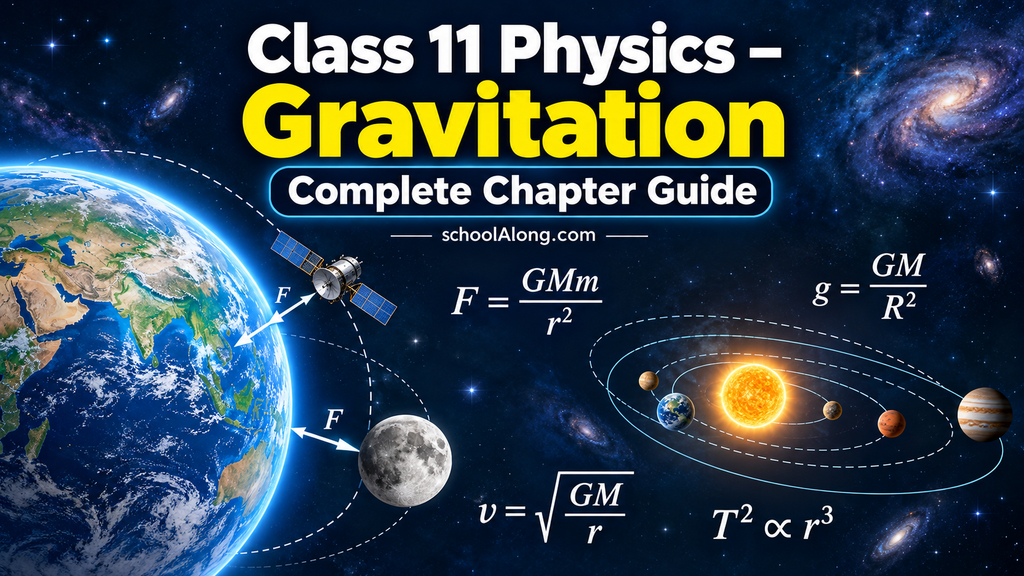
Study Class 11 Physics Gravitation from NCERT with complete concepts, derivations, formulas, applications, graphs, and JEE & NEET problem-solving approaches.
Class 11 Physics Gravitation – NCERT Complete Chapter Guide
Gravitation is one of the most important chapters in Class 11 Physics because it connects several fundamental ideas: force, circular motion, energy, momentum, potential energy, satellites and planetary motion.
This chapter is important not only for understanding the NCERT syllabus, but also for solving many JEE and NEET Physics problems.
In this complete guide, we will study Gravitation in a connected way:
Concept → Derivation → Formula → Meaning → Application → Graph/Trend → Common Trap → JEE/NEET Approach
The chapter follows the structure of the NCERT Class 11 Physics chapter “Gravitation”, including Kepler’s laws, universal gravitation, gravitational constant, acceleration due to gravity, variation of , gravitational potential energy, escape speed, satellites and orbital energy.
Important: This guide is designed to build strong NCERT foundations and cover major JEE/NEET-level concepts and standard problem patterns. Competitive-exam questions can combine Gravitation with other chapters, so no single chapter guide can guarantee the ability to solve literally every possible JEE/NEET question.
Table of Contents
- What Is Gravitation?
- Kepler’s Laws of Planetary Motion
- Universal Law of Gravitation
- Superposition Principle
- Gravitation and Spherical Bodies
- Gravitational Constant
- Acceleration Due to Gravity
- Relation Between , , and
- Variation of with Height
- Variation of with Depth
- Gravitational Potential Energy
- Gravitational Potential
- Escape Speed
- Earth Satellites
- Orbital Speed of a Satellite
- Time Period of a Satellite
- Kepler’s Third Law for Satellites
- Energy of an Orbiting Satellite
- Weightlessness in a Satellite
- Important Graphs and Trends
- Important Formula Relationships
- JEE/NEET Problem-Solving Approach
- Common Mistakes and Traps
- Quick Revision Sheet
- Final Chapter Checklist
- FAQs
1. What Is Gravitation?
Gravitation is the universal attractive interaction between masses.
Every object having mass attracts every other object having mass.
For example:
- Earth attracts a stone.
- Earth attracts the Moon.
- Sun attracts Earth.
- Earth attracts artificial satellites.
- Two ordinary objects also attract each other gravitationally, although that force is usually extremely small.
The gravitational interaction explains both:
- objects falling towards Earth, and
- the motion of planets and satellites.
This is one of the central ideas of the chapter.
2. Kepler’s Laws of Planetary Motion
Before Newton developed the universal law of gravitation, Johannes Kepler described planetary motion using three laws.
These laws are extremely important because many competitive-exam questions use them directly or combine them with Newton’s law of gravitation.
2.1 Kepler’s First Law — Law of Orbits
Every planet moves in an elliptical orbit, with the Sun situated at one of the foci of the ellipse.
For a circle, the two foci merge into one point, and the semi-major axis becomes the radius.
Important terms
- Perihelion: closest point of the planet from the Sun
- Aphelion: farthest point from the Sun
- Semi-major axis: half of the major axis of the ellipse
Exam idea
A common conceptual question is:
Where is the planet moving faster — near perihelion or aphelion?
Answer:
Near perihelion.
The reason comes from Kepler’s second law.
2.2 Kepler’s Second Law — Law of Areas
The line joining the Sun and a planet sweeps out equal areas in equal intervals of time.
Mathematically,
For a small time interval,
Therefore,
Since angular momentum is
and
we get
For a central force, angular momentum remains conserved. Therefore,
This gives Kepler’s second law.
What does this mean physically?
When the planet is closer to the Sun:
so its speed must increase to maintain the same areal velocity.
Therefore,
for perihelion and aphelion when the velocity is perpendicular to the radius at those points.
Hence,
because
JEE/NEET Pattern
If a question gives:
and asks for the ratio of speeds,
This is much faster than using a long derivation.
2.3 Kepler’s Third Law — Law of Periods
The square of the orbital period is proportional to the cube of the semi-major axis:
For planets orbiting the same central body,
Therefore,
For circular orbit
Since
we have
JEE/NEET Shortcut
Suppose one planet has orbital radius twice that of another:
Then
Therefore,
No numerical calculation is required.
3. Universal Law of Gravitation
Newton’s universal law of gravitation states that every two masses attract each other with a force:
- directly proportional to the product of their masses, and
- inversely proportional to the square of the distance between their centres.
For masses and separated by distance ,
where is the universal gravitational constant.
3.1 Dependence on Mass
From
we get
and
Therefore:
- if one mass doubles, force doubles;
- if both masses double, force becomes four times;
- if one mass becomes half, force becomes half.
Example
If
and
then
3.2 Dependence on Distance
Therefore:
If distance becomes ,
If distance becomes ,
If distance becomes ,
Common Trap
Do not use
The correct relation is
3.3 Gravitational Force Is Attractive
Gravitational force always acts along the line joining the two masses and is attractive.
For vector problems, direction is extremely important.
The magnitude is
but the net force must be obtained using vector addition.
4. Superposition Principle
If a mass is acted upon by several masses, calculate each gravitational force separately and then add them vectorially.
If
act on a particle, then
Exam strategy
For multiple-mass problems:
Step 1: Draw the object.
Step 2: Mark the direction of every gravitational force.
Step 3: Calculate each force.
Step 4: Resolve into components if necessary.
Step 5: Add the vectors.
Common Trap
Never add gravitational force magnitudes directly unless all forces are acting in the same direction.
5. Gravitation and Spherical Bodies
A very important NCERT result is the behaviour of a spherically symmetric body.
For a point outside a uniform spherical shell or spherically symmetric solid sphere, the body behaves gravitationally as though its entire mass were concentrated at its centre.
Therefore, outside Earth:
where is measured from Earth’s centre.
Inside a Uniform Spherical Shell
For a particle inside a uniform spherical shell:
The gravitational force due to the shell itself cancels out.
But remember:
A spherical shell does not shield a particle from gravitational effects of other external bodies.
This is different from electrostatic shielding.
6. Gravitational Constant
The universal gravitational constant is
Its SI unit is:
Using
we can obtain its dimensions:
Since
we get
vs
Do not confuse these two.
| Universal gravitational constant | Acceleration due to gravity |
| Same value everywhere | Depends on location |
| SI | About near Earth’s surface |
| Constant of proportionality | Acceleration |
7. Acceleration Due to Gravity
Consider a body of mass on Earth’s surface.
Earth has mass and radius .
Gravitational force:
From Newton’s second law:
Therefore,
Cancel :
This is one of the most important formulas in Gravitation.
What Does This Formula Tell Us?
Therefore,
and
So a planet with greater mass can have greater , while a larger radius tends to reduce for a fixed mass.
Important Concept
The mass of the falling body does not appear in
Therefore, in the ideal gravitational model, acceleration due to gravity is independent of the mass of the falling object.
8. Variation of with Height
Suppose a body is at height above Earth’s surface.
Its distance from Earth’s centre is:
Therefore,
Since
we get
Important Conclusion
As increases:
Small Height Approximation
If
then
This approximation is particularly useful in numerical problems involving small heights.
Example
If height is very small compared with Earth’s radius and
then
So decreases by approximately .
9. Variation of with Depth
Now consider a point at depth below Earth’s surface.
For the NCERT derivation, Earth is assumed to have uniform density.
The distance from Earth’s centre is:
The resulting relation is
Important Conclusions
At the surface:
so
At the centre:
therefore,
So under the uniform-density model:
Compare Height and Depth
Above Earth
The exact relation is inverse-square.
Below Earth
Under the uniform-density model:
The relation is linear.
Common Trap
Do not use the depth formula for height.
10. Gravitational Potential Energy
Gravitational force is a conservative force.
Therefore, gravitational potential energy can be defined.
If a mass is at distance from a mass , and potential energy is taken as zero at infinity:
The negative sign is extremely important.
Why Is Gravitational Potential Energy Negative?
We choose
at infinity.
A bound object near a massive body has lower energy than it would have at infinity.
Therefore,
for a gravitationally bound configuration under this convention.
As ,
10.1 Change in Potential Energy
If an object moves from to :
Therefore,
This is more general than using .
10.2 When Can We Use ?
Near Earth’s surface, when the change in height is small compared with Earth’s radius, can be treated approximately constant.
Then:
But is an approximation to the more general gravitational potential-energy difference.
This distinction is important in JEE-level questions.
11. Gravitational Potential
Gravitational potential is potential energy per unit mass.
For a mass :
Therefore,
Unit
The SI unit of gravitational potential is:
which is equivalent to:
11.1 Potential Due to Multiple Masses
Because gravitational potential is a scalar, potentials can be added algebraically.
For several masses:
This is often easier than calculating gravitational force because force is a vector while potential is a scalar.
JEE/NEET Tip
If a question asks for potential at a point due to several masses, calculate each potential and add them with their signs.
12. Escape Speed
Escape speed is the minimum initial speed required for an object to escape Earth’s gravitational influence and reach infinity with zero final speed in the limiting case.
At Earth’s surface:
Using
we get:
For Earth:
12.1 Derivation of Escape Speed
At Earth’s surface:
Initial kinetic energy:
Initial potential energy:
At infinity, for minimum escape condition:
and
Conservation of mechanical energy gives:
Therefore,
and
12.2 Does Escape Speed Depend on the Mass of the Object?
No.
Notice that cancels during the derivation.
Therefore:
for a given planet and launch location under the ideal model.
12.3 Escape Speed at Height
At a distance
from Earth’s centre:
Therefore, escape speed decreases as height increases.
12.4 Escape Speed and Orbital Speed
For a satellite very close to Earth’s surface:
while
Hence:
This is a very common competitive-exam relation.
13. Earth Satellites
A satellite is an object that revolves around Earth under Earth’s gravitational influence.
Satellites may have circular or elliptical orbits.
For a circular orbit of radius
the gravitational force provides the required centripetal force.
14. Orbital Speed of a Satellite
For a satellite of mass :
Gravitational force:
Centripetal force:
Equating them:
Cancel :
Therefore:
Since
we get:
Important Result
Therefore:
Higher orbit → lower orbital speed.
This is an important conceptual question.
15. Time Period of a Satellite
The satellite travels one circumference:
Therefore,
Substitute
Then:
Therefore:
or
Hence:
This is Kepler’s third law applied to satellites.
15.1 Important Ratio Formula
For two satellites around the same planet:
This is one of the fastest ways to solve satellite-period questions.
Example
If
then:
So the second satellite takes 8 times the period.
16. Satellite Speed vs Height
Since
we have:
Therefore:
- height increases → orbital speed decreases
- height decreases → orbital speed increases
17. Satellite Energy
For a circular orbit of radius :
Kinetic Energy
Using
we get:
Potential Energy
Taking gravitational potential energy as zero at infinity:
Total Mechanical Energy
Therefore:
Hence:
17.1 The Most Important Satellite Energy Relations
From:
and
we obtain:
and since
we get:
Also:
Therefore:
These relations are extremely useful in numerical and conceptual questions.
17.2 Why Is Satellite Energy Negative?
For a satellite in a bound orbit:
A negative total mechanical energy indicates a bound system under the chosen zero of potential energy at infinity.
If sufficient energy is supplied to make the total energy reach zero or positive values, the object can escape in the idealized gravitational model.
18. What Happens When Satellite Moves to a Higher Orbit?
Suppose a satellite moves from to , where
Orbital speed
So:
Kinetic energy
So:
Potential energy
As increases, becomes less negative:
Total energy
Therefore:
but it remains negative for a bound circular orbit.
19. Weightlessness in a Satellite
Astronauts inside an orbiting satellite experience apparent weightlessness.
This does not mean that Earth’s gravitational force has become zero.
The satellite and the astronaut are both continuously falling towards Earth under gravity.
They are in free fall together.
Therefore, the normal reaction that ordinarily produces the sensation of weight is absent or greatly reduced in the idealized model.
Common Trap
Wrong idea:
“There is no gravity in space.”
Correct idea:
Gravity is still acting; the astronaut and spacecraft are in free fall.
20. Important Graphs and Trends
Graphs are important because many JEE/NEET questions test qualitative understanding.
20.1 vs Height
Exact relation:
As increases:
The decrease is not linear for arbitrary large .
20.2 vs Depth
For the uniform-density Earth model:
Therefore, the graph is a straight line from:
to
20.3 Orbital Speed vs Orbital Radius
Therefore:
Higher orbit → lower speed.
20.4 Time Period vs Orbital Radius
Therefore:
Higher orbit → longer time period.
20.5 Gravitational Potential vs Distance
As increases:
from the negative side.
20.6 Gravitational Potential Energy vs Distance
Similarly:
as
21. Formula Relationship Map
Instead of memorising every formula separately, understand how they are connected.
Fundamental relation
From Newton’s second law:
At Earth’s surface:
For circular orbit:
giving:
Then:
giving:
Energy:
gives:
Potential energy:
Therefore:
Escape speed:
So for the same radius:
This relationship map is much more powerful than memorising isolated equations.
22. JEE/NEET Problem-Solving Approach
For competitive exams, do not immediately substitute numbers into a formula.
First identify what physical situation the question describes.
Pattern 1 — Direct Gravitational Force
Use:
Typical question:
Mass is doubled and distance is tripled. What happens to force?
Think proportionally:
Therefore:
Pattern 2 — Comparing on Two Planets
Use:
Therefore:
This avoids calculating separately.
Pattern 3 — Height Above Earth
Use:
If , use:
Do not use the approximation when the height is not small compared with Earth’s radius.
Pattern 4 — Depth Below Earth
Under the uniform-density assumption:
Pattern 5 — Escape Speed
If the question asks:
- minimum speed to escape,
- escape from Earth’s surface,
- escape speed from another planet,
think:
or
when is the surface acceleration due to gravity.
Pattern 6 — Satellite Speed
If the satellite is in circular orbit:
Remember:
Pattern 7 — Satellite Period
Use:
For ratio questions:
Pattern 8 — Satellite Energy
Immediately write:
Then use:
Pattern 9 — Kepler’s Law
If two planets orbit the same central body:
This is usually the fastest method for ratio-based planetary-motion problems.
Pattern 10 — Multiple Masses
Use the superposition principle.
For force:
For potential:
Remember:
Force → vector addition
Potential → scalar addition
This distinction can save considerable time in competitive exams.
23. Common Mistakes and Exam Traps
Trap 1: Confusing and
They are completely different physical quantities.
Trap 2: Using Instead of
At height :
not .
Trap 3: Using incorrectly
At depth :
But the final uniform-density relation is:
Trap 4: Thinking Escape Speed Depends on Object Mass
It does not.
Trap 5: Thinking Higher Satellite Means Higher Orbital Speed
Wrong.
So:
Trap 6: Thinking Higher Satellite Means Shorter Period
Wrong.
Therefore:
Trap 7: Forgetting the Negative Sign in Potential Energy
With zero potential energy at infinity:
Trap 8: Treating as the Universal Formula
For small height changes near Earth’s surface:
For general gravitational problems:
Trap 9: Adding Forces Like Scalars
If forces point in different directions, vector addition is required.
Trap 10: Saying Weightlessness Means Zero Gravity
In an orbiting spacecraft, gravity is still acting.
The spacecraft and astronaut are in free fall.
24. Important Limiting Cases
Understanding limiting cases is an excellent JEE-level habit.
As
At Earth’s centre in the uniform-density model
As satellite radius increases
and
in the ideal mathematical limit.
Escape condition
For the limiting escape case:
For a bound orbit:
25. Most Important Derivations to Master
For JEE/NEET preparation, do not merely memorise the final formulas. You should be able to reproduce the logic behind these derivations.
Must-know derivations
- Kepler’s second law from conservation of angular momentum
- Small-height approximation
- under uniform-density assumption
- Gravitational potential energy
- Gravitational potential
- Escape speed
- Orbital speed
- Satellite time period
- Satellite kinetic energy
- Satellite potential energy
- Total energy of a satellite
If these are conceptually clear, many apparently different questions become variations of the same ideas.
26. One-Page Gravitation Formula Sheet
Universal Gravitation
Gravitational Constant
Surface Gravity
Gravity at Height
For :
Gravity at Depth
Gravitational Potential Energy
Gravitational Potential
Escape Speed
or
Orbital Speed
Escape-Orbit Relation
Satellite Time Period
Kepler’s Third Law
Satellite Kinetic Energy
Satellite Potential Energy
Satellite Total Energy
Energy Relations
27. Final Chapter Checklist
Before considering Gravitation complete, a student should be able to answer yes to these questions:
Concepts
- Can I explain universal gravitation?
- Can I explain all three Kepler laws?
- Can I explain why planets move faster near perihelion?
- Can I distinguish from ?
- Can I explain superposition?
- Can I explain why the gravitational force inside a uniform spherical shell is zero?
Derivations
- Can I derive ?
- Can I derive gravity at height?
- Can I derive gravity at depth under the uniform-density assumption?
- Can I derive escape speed?
- Can I derive orbital velocity?
- Can I derive satellite time period?
- Can I derive satellite energy relations?
Numerical Applications
- Can I solve mass-distance scaling problems?
- Can I compare gravity on different planets?
- Can I solve height/depth questions?
- Can I solve escape-speed questions?
- Can I solve orbital-speed questions?
- Can I solve satellite-period ratio questions?
- Can I solve satellite-energy questions?
Conceptual Questions
- Why is gravitational potential energy negative?
- Why does orbital speed decrease with orbital radius?
- Why does the time period increase with orbital radius?
- Why does an astronaut experience weightlessness?
- Why is total energy of a bound satellite negative?
If the answer to these is yes, the student has built a strong Gravitation foundation.
NCERT + JEE/NEET Learning Path
This Complete Chapter Guide should be studied first.
Then continue with the other three Gravitation resources on schoolAlong:
1. Complete Chapter Guide
→ Learn the chapter deeply
2. Gravitation Notes
→ Revise the chapter quickly
3. Gravitation NCERT Solutions
→ Practise NCERT Examples and Exercises
4. Gravitation Important Questions & MCQs
→ Test concepts and practise JEE/NEET-style problems
This creates a simple learning cycle:
Learn → Revise → Solve → Test
Conclusion
Gravitation becomes much easier when the formulas are not treated as isolated equations.
The central chain is:
↓
↓
↓
↓
and
Once these relationships are understood rather than simply memorised, a large number of NCERT, NEET and JEE Gravitation problems can be approached systematically.
The goal is not to remember hundreds of formulas.
The goal is to understand why the formulas work, when they apply, and how they are connected.
FAQs
1. What is Gravitation in Class 11 Physics?
Gravitation is the study of the attractive interaction between masses, including planetary motion, gravitational force, acceleration due to gravity, potential energy, escape speed and satellite motion.
2. What are the three laws of Kepler?
They are the law of orbits, law of areas and law of periods.
3. What is the formula for gravitational force?
4. What is the value of ?
5. What is the formula for acceleration due to gravity?
6. Does depend on the mass of the falling object?
No. In the ideal model, the mass of the falling object cancels out.
7. How does change with height?
It decreases according to:
8. How does change with depth?
For the uniform-density Earth model:
9. Why is gravitational potential energy negative?
When zero potential energy is chosen at infinity, a bound gravitational system has lower potential energy than at infinity, giving a negative value.
10. What is the formula for gravitational potential energy?
11. What is escape speed from Earth?
Approximately:
12. Does escape speed depend on the mass of the projectile?
No.
13. What is the orbital speed of a satellite?
14. What happens to orbital speed when satellite height increases?
Orbital speed decreases.
15. What happens to the time period when orbital radius increases?
The time period increases according to:
16. What is the total energy of a circular satellite?
17. What is the relation between satellite kinetic and potential energy?
18. Why do astronauts feel weightless?
Because the spacecraft and astronauts are in free fall under Earth’s gravitational influence.
19. Is there gravity in an orbiting spacecraft?
Yes. Weightlessness does not mean that Earth’s gravitational force is zero.
20. Is Gravitation important for JEE and NEET?
Yes. The concepts of gravitational force, , potential energy, escape speed, satellites and Kepler’s laws form an important part of Class 11 Physics preparation for competitive examinations.

Leave a Reply